



Optimizing Your IoT Communications with Radio Frequency (RF) Filters
When setting up an IoT deployment project, the reliability of radio communication is a key factor. Every piece of transmitted data must travel without interference to ensure quality of service.
However, in recent years, the number of connected devices has skyrocketed, and the radio frequencies dedicated to IoT (between 865 MHz and 870 MHz in EMEA) have become increasingly crowded with messages. Between Wi-Fi, Bluetooth, RFID, cellular (3G, 4G, 5G) and LoRaWAN signals, interferences are everywhere.
To ensure stable and efficient communication, IoT equipment must be able to effectively filter useful signals and reject those that compromise the reception. This is where radio frequency (RF) filters come in — lesser-known but essential components for successful IoT deployment.
Two types of RF filter technologies stand out and will be the focus of our discussion today: SAW filters and cavity filters.
The Essential Role of Filters
As mentioned above, a radio frequency (RF) filter allows only the desired frequencies to pass through and blocks all others that should not reach the receiver. Without effective filtering, your message would be drowned in a sea of noise, leading to data loss, reduced range, or unstable communications.
These problems are especially critical in IoT, where communication devices operate at low power levels (as in the LoRaWAN network, which uses unlicensed frequency bands).
A filter therefore ensures:
- Better ability to isolate a specific frequency band,
- Low insertion loss, so the signal retains its strength,
- Robustness against interference, which is essential in urban or industrial areas (especially in co-located environments).
SAW Filters
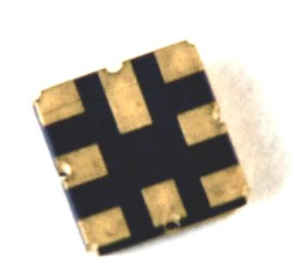
Saw Filter (2x2x2mm)
SAW filters (Surface Acoustic Wave) are among the most widely used in the world of connected devices.
Their operation is based on the following principle: SAW filters rely on a special material called piezoelectric, which can transform an electrical signal into a small wave that travels along the surface of the component. This wave is then converted back into an electrical signal — but only within the desired frequency range.
SAW filters offer several advantages. First, they are small and compact components. They are also inexpensive to produce. Additionally, they provide good stability at low and medium frequencies, ensuring reliable communication. Their low insertion losses also make them an ideal choice.
However, SAW filters are less efficient at very high frequencies and can be sensitive to temperature variations. BAW (Bulk Acoustic Wave) filters are now commonly used for frequencies above 2GHz.
SAW filters are also less effective in co-location scenarios due to limited cutoff slopes.
In fact, every Kerlink gateway contains three SAW filters (two for the reception – to offer high attenuation of the interferences – and one for the transmission – to reduce the out-of-band spurious –).
Cavity Filters
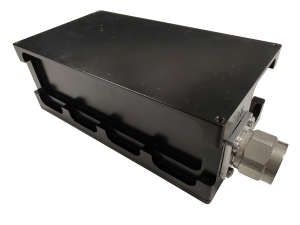
Cavity Filter
Cavity filters operate on a completely different principle. Here, the electromagnetic signal passes through one or more metallic cavities that resonate only at the desired frequency. This resonance acts as a natural selective filter, effectively eliminating unwanted frequencies.
Cavity filters offer several key advantages:
- Excellent selectivity, allowing the useful signal to be isolated even when surrounded by many other signals,
- Low signal loss, maintaining strong, stable transmission after filtering,
- High robustness, as they withstand high temperatures, climate variations, and vibrations,
- Customizability, since they can be designed to operate on specific frequency bands according to network needs.
At Kerlink, we strongly recommend using cavity filters for deployments mainly in Asia and the Americas, where LoRa frequency bands are very close to the downlink cellular bands. In our Wirnet 64 Highway, a cavity filter is already embedded.
For other regions, the use of a cavity filter depends mainly on the environment in which the gateways are located. We always provide custom-made cavity filters to offer our clients the best possible field performance. It is entirely possible to purchase a Wirnet iStation or Wirnet iBTS and add our cavity filter alongside the product.
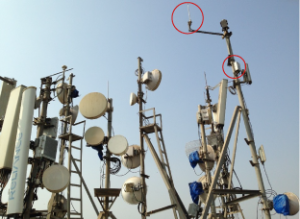
However, cavity filters do not solve every possible issue! Out-of-band spurious generated by high-power transmitters and/or LTE base stations with wide or medium coverage can still cause LoRaWAN gateway desensitization if minimum vertical and horizontal spatial separation distances are not respected.
To conclude
Radio frequency filters play a crucial role in ensuring the quality and reliability of IoT communications. Thanks to them, signals integrity is preserved, interference is reduced, and data exchanges between connected devices are reliable.
However, it’s important to remember that even a high-performance cavity filter is not an absolute guarantee.
Minor residual frequencies from nearby transmitters can persist, especially when multiple devices are installed close to each other. That’s why installation quality is just as important as hardware choice. To prevent interference, it is recommended to maintain minimum vertical and horizontal distances between antennas and transmitters.
We always provide our clients with the best guidance and recommendations for each IoT project to help them achieve successful network deployment.
We also remind them that poor installation quality can quickly degrade network performance and lead to significant additional costs if adjustments need to be made afterward.