



Lightning Protection: A Key Challenge for Outdoor LPWAN Equipment
Users of LPWAN networks and outdoor electronic equipment more broadly must carefully anticipate the risks associated with lightning‑induced overvoltage. Without proper protection, a single strike can be enough to shut down an entire infrastructure site.
In this blog post, we explain the different types of lightning impacts, their potential effects on equipment, and the best practices to implement in order to ensure effective protection and guarantee continuous service for your gateways.
Lightning: A Major Risk for Outdoor Electronic Equipment
When deploying electronic equipment outdoors, the devices are exposed to many environmental constraints such as rain, wind and extreme temperatures…
However, lightning remains the main hazard and the one that can cause the most severe damage.
If a lightning strike hits a gateway antenna directly without adequate protection, the equipment can be permanently damaged.
This is why lightning protection must be considered from the very beginning of the installation design phase.
Direct Lightning and Indirect Lightning: Understanding the difference
Direct lightning refers to a strike that hits an antenna, a mast or a piece of equipment. In this situation, the amount of energy transferred is extremely high and always results in the destruction of the affected devices.
Direct lightning strikes must therefore be prevented through the use of dedicated systems such as lightning rods, which safely channel the surge to the ground. Surge protectors should also be installed as an additional safeguard to protect the equipment.
Some regions of the world are far more exposed to lightning than others (as shown in the map below), which makes it essential to adapt installations to local geographical condition.
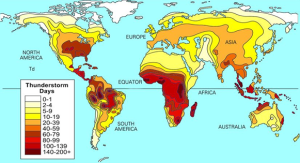
World map showing the average number of thunderstorm days per year
Indirect lightning is often underestimated as a risk
Even without a direct strike, lightning can cause significant damage:
- Ground Propagation
When lightning strikes the ground, electrical currents can travel over long distances, rise through infrastructure, and propagate along cables into electronic equipment. - Overvoltages via power lines
A strike on a power line can generate transient overvoltages capable of damaging or destroying connected equipment. - Electromagnetic coupling
A lightning strike can also produce electromagnetic fields that are picked up by antennas or cables, leading to dangerous overvoltages in the absence of adequate protection.
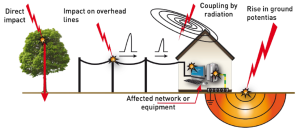
Indirect effects of lightning – Source CITEL
Protection solutions recommended by Kerlink
1. A robust gateway design
Kerlink gateways are designed to withstand demanding environments. They notably feature a grounded metal enclosure, which helps mitigate the effects of electromagnetic disturbances and enhances overall protection against lightning.
2. Installation of Surge Protection Devices on External Interfaces
Kerlink strongly recommends installing surge protection devices on all external interfaces, including:
- The external antenna,
- The power supply (PoE or DC),
- Exposed communication links (Ethernet).
These devices are installed directly on the gateway’s external input/output interfaces and must be properly grounded. All Kerlink gateways are equipped with a dedicated grounding point for this purpose.
Key point: Protection devices must be installed as close as possible to the gateway, with short grounding cables, in order to effectively limit overvoltages.
Why prioritize external protection devices?
Some gateways on the market incorporate lightning protection only internally, directly on the PCBA (Printed Circuit Board Assembly).
This approach presents a significant risk: overvoltages can enter the equipment without necessarily being immediately diverted to the protection components, potentially causing irreversible internal damage.
At Kerlink, the approach is clear: act upstream, as close as possible to the entry points, to prevent overvoltages from entering the system and to ensure effective, long-lasting protection of your equipment.
Protect your gateways and the installation site as well
Protecting your LPWAN equipment with surge protection devices is necessary, but often not sufficient. Overvoltages captured by installation cables can be conducted into buildings, potentially damaging indoor equipment such as PoE injectors.
It is therefore essential to prevent these overvoltages from entering buildings by strategically installing surge protection devices on these cables at the building entry point.
Conclusion
The reliability of LPWAN networks depends on equipment capable of operating over the long term, regardless of external conditions.
At Kerlink, the safety of your installations and the protection of your products are paramount. That is why our teams support and advise you on best practices for lightning protection, helping to minimize the risk of service interruptions and equipment damage.